blog

Diversity Actually Communicates: Domestic Intercultural Competence

By Mari D. González
Inter-ethnic relations have been taboo in the U.S. because assimilation has been expected from immigrants and minorities. Assimilation has mainly occurred among people from countries with less cultural and linguistic distances (Anglo-Saxon, Ireland, France)—for whom the term expatriates are used—or among people who are not seen as “others.”
In the last decade due to fast technological advancements such as the Internet, social media, and cell phones, many immigrants are not assimilating. While there is a great level of acculturation to the American way of doing business—mostly by college graduates, immigrants and ex-pats bring and keep their own worldviews, perspectives, and values representative of their first language and culture of origin.
Minorities in the U.S. who live in silos have strengthened their diversities. The more an ethnic group is segregated, excluded, or other-ed, the less it assimilates. Diversity is a positive aspect. It enriches any company, organization, or team. Silicon Valley, Tech Venture Capitalist, Paul Graham explains, “The United States has only 5 percent of the world’s population; it stands to reason that most of the world’s best new ideas will be thought up by people who weren’t born here.”
The challenge is when communication styles clash let alone the perpetuation of harmful stereotypes. It results in misunderstandings, frustration, decreased productivity, and lower morale. We all have seen this!
How Does Intercultural Competence in the Workplace Looks Like?

By Mari D. González
I conducted a series of training sessions last year for a company whose employees are close to 50 percent Latinos of which about 30 percent are not fully bilingual. The communication across cultures is as challenging for English-dominants as it is for Spanish-dominants.
Several Asian-American employees also work for this company. Their communication style is different from Americans as well as from Latinos which enriched our training activities and discussions.
At the end of the mixed-group training sessions, I asked participants to brainstorm on what they had learned and what has worked for them in the past that they can apply when communicating with someone outside their primary culture and language.
My question was, based on what you have learned during training and from your own personal experience, what do you recommend when working with people from different cultures?
I wanted the “takeaways” to come from them instead of me. This is what they came up with:
- Have a positive attitude.
- Do not be afraid to ask questions.
- Use “yes or no” questions.
- When unclear, ask again, paraphrase and repeat.
- When something is critical, communicate face-to-face.
- Use non-verbal communication such as hand gestures.
- Ask for help when needed; simply say “I need help.”
- Talk slowly, not necessarily louder.
- Avoid the use of slang.
- Show it instead of telling it.
- Use pictures and visual aids if possible.
- Give a warning upfront if your second language skills are limited.
Understanding Geert Hofstede’s Four Manifestations of Culture
By Mari D. González
As an cross-cultural consultant, I was trained to analyze communication across cultures and to interpret the differences and similarities among various ethnic groups. One model that is useful when examining culture across nationalities for international marketing or across ethnicities within a country is Geert Hofstede’s Four Manifestations of Culture, (Hofstede, Hofstede, & Minkov, 2010).
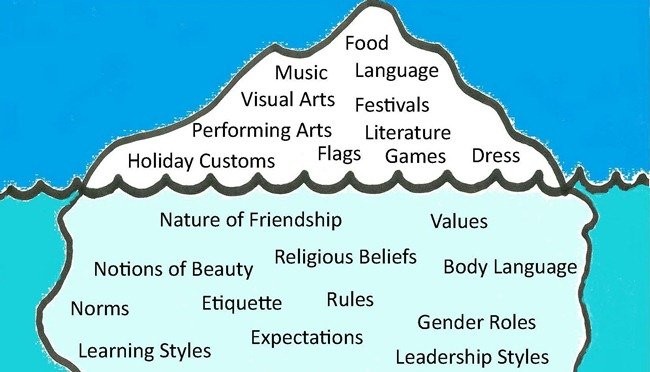
Hofstede categorizes the expression of culture from what is most obvious to what is most difficult to perceive and understand. This can be compared to an iceberg in which the symbols, heroes, and rituals are at the tip–the smaller visible area–and the values are hidden and invisible, yet they form the larger area. Below are examples of the Four Manifestations of Culture:
1. SYMBOLS: Colors, food, words, flags, dress, jargon, commodities, and so on.
2. HEROES: Real or unreal characters that personify what is highly prized within a group or nation and who serve as role models or leaders.
3. RITUALS: Collective activities that are essential to maintain cultural groups’ cohesion. For instance, U.S.-born Latino youth watching a soccer game in Spanish with their parents and grandparents is considered a ritual.
4. VALUES: The most subjective and less visible expressions of culture that influence concepts, notions, expectations, perceptions, worldview, and so on.
Most people in general are familiar with the first three of Hofstede’s manifestations because those are learned at home or school while growing up during a process called “enculturation.” To analyze the not so obvious aspects of culture, which are the in-culture shared values, academic training in cross-cultural communication theory and an inherent curiosity are necessary. To be effective in intercultural communication, we need to see beyond our own ethnocentric tendencies by observing differences with total openness. It takes acknowledging and analyzing our own personal biases and stepping out of our comfort zones.
I have heard from many people who say they love learning about other cultures and that is the reason they travel the world and have friends of different ethnicities and nationalities. Traveling exposes people to symbols, the first manifestation of culture, and mingling outside one’s cultural group exposes people to both heroes and rituals. Yet, we can only learn about culture—the stuff that groups share—through socializing, and from close socializing or through acquiring training in cross-cultural communication plus observation and self-inquiry.
To include diverse participants whether your students, your clients, patients, or even your own employees, it is essential to have a basic understanding of cross-cultural communication in order to attain a broader perspective and a deeper understanding of our culturally differences. Finally, only the analysis is cross-cultural. The participants are increasingly diverse because our societies are becoming more multicultural.
REFERENCES:
Hofstede, G., Hofstede, G. J., & Minkov, M. (2010). Cultures and Organizations: Software of the Mind. Revised and expanded 3rd Edition. New York: McGraw-Hill
* The image by James Penstone is licensed under a Creative Commons Attribution-NonCommercial-ShareAlike 2.0 UK: England & Wales License.
Unlocking Cross-Cultural Communication in the Indian Context

By Mari D. González
This article is in response to a request I received on my blog. Based on the greeting, I assumed it came from a person in India. Please read below:
“Dear ma’am,
Can you please explain the difference between intercultural communication and cross-cultural communication in the Indian context or in the form in which we can make a role- play. It is very important to us but we could not find the proper explanation anywhere on the internet.”
In 2011, while in graduate school, I wrote an article titled, CROSS-CULTURAL vs. INTERCULTURAL, after listening to an awkward, inaccurate, and rather dismissive explanation of these terms at a large O’Reilly marketing conference in San Francisco. This blog article gets an average of 35 views per day from all over the world and I often get contacted with additional questions such as the one today.
Because it sounded as if this was related to a school assignment and because I love these topics, I answered diligently. Please see my reply below:
“Intercultural communication is what happens, for example, when a Punjabi marries a Bengali. Think of the wedding conversations or even the miscommunication ‘between’ the families from both sides.
Cross-cultural communication relates to your own ideas and knowledge about Punjabis vs Bengalis. It does not require interaction, only observation, and interpretation. You could say, Punjabis are very extroverted in the context of Bengalis, for example.
If you read my previous article, you’ll notice that it is merely a cross-cultural analysis of Mexican and Indian philosophies based on my own experience and understanding. It is not an intercultural communication analysis because I am not referring to what happens when a philosopher from Mexico meets another philosopher from India.”
Please let me know if this makes sense. I’ll be happy to continue this conversation. Best wishes on your assignment!”
The response I received was, “Yes, It makes sense, Thank you so much!!.”
You can find more articles in this category, here.
*Picture from From Wikimedia Commons; File: Indian Wedding Ceremony (413).jpg; Author: Benipal Hardarshan
Accents and Cultural Identity Formation

By Mari D. González
“I have traveled more than anyone else, and I have noticed that even the angels speak English with an accent” ~Mark Twain
I love accents. I find them intriguing. They tell me that the speaker is bilingual. Accents define people socioculturally and correlate to their upbringing and ethnic, national, or group identity. Some accents are difficult to understand, some are melodious, and some take time to get used to. Our evaluations are subjective and relative to our personal opinions.
I am accustomed to accents. In California, there are immigrants in different professions including medical. I have interpreted for doctors from China and India who are not understood by patients with good second-language English fluency. Such difficulty is due to the patients’ lack of familiarity with people from those countries or perhaps they simply are not as intrigued as I am.
I came across an article written by a Peruvian author who spoke about the need to diminish one’s accent because “having a Spanish accent is seen as a minus.” None of my non-English-dominant colleagues have ever discussed accent reduction. This isolated “accent” perspective does not reflect the overall Latino/Hispanic concern.
Some immigrants demonstrate a greater desire to assimilate than Mexicans. It indicates a desire to fitting in instead of integrating. Mexican-American have a different perception of assimilation and actually oppose it. This opposition might be in response to U.S.-Mexican-specific historical factors.
The background of the current state of Latinos/Hispanics in the U.S. is the Chicano Movement. Whether we agree with it or not, the Chicano Movement is a point in history that precedes where we are now as a cultural group. It defines the second developmental stage of group identity formation called “Conflict.”
The first developmental stage of group identity formation is called “Identification with the dominant culture.” It is a desire to eliminate what makes one different from members of the dominant culture or assimilation. The author’s desire to reduce his accent implies being at this first developmental stage described as having a preference for an Anglo Orientation according to the research by Vasti Torres.
Reading Latino writers such as Rodolfo Acuña, Gloria Anzaldua, Hayes-Bautista, researcher, professor Amado Padilla, and journalist, Gregory Rodriguez help us understand the past and present context of Latino identity in the U.S. and why some people have a desire to assimilate and others to integrate.
Latest Posts
-
Diversity Actually Communicates: Domestic Intercultural Competence
By Mari D. González Inter-ethnic relations have been taboo in the U.S. because assimilation has been expected from immigrants and minorities. Assimilation has mainly…
-
How Does Intercultural Competence in the Workplace Looks Like?
By Mari D. González I conducted a series of training sessions last year for a company whose employees are close to 50 percent Latinos…
-
Understanding Geert Hofstede’s Four Manifestations of Culture
By Mari D. González As an cross-cultural consultant, I was trained to analyze communication across cultures and to interpret the differences and similarities among various…

 IXMATI