Home » Posts tagged 'Geert Hofstede'
Tag Archives: Geert Hofstede
Understanding Geert Hofstede’s Four Manifestations of Culture
By Mari D. González
As an cross-cultural consultant, I was trained to analyze communication across cultures and to interpret the differences and similarities among various ethnic groups. One model that is useful when examining culture across nationalities for international marketing or across ethnicities within a country is Geert Hofstede’s Four Manifestations of Culture, (Hofstede, Hofstede, & Minkov, 2010).
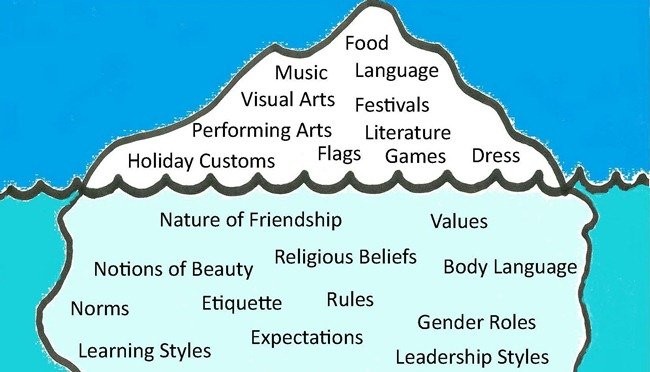
Hofstede categorizes the expression of culture from what is most obvious to what is most difficult to perceive and understand. This can be compared to an iceberg in which the symbols, heroes, and rituals are at the tip–the smaller visible area–and the values are hidden and invisible, yet they form the larger area. Below are examples of the Four Manifestations of Culture:
1. SYMBOLS: Colors, food, words, flags, dress, jargon, commodities, and so on.
2. HEROES: Real or unreal characters that personify what is highly prized within a group or nation and who serve as role models or leaders.
3. RITUALS: Collective activities that are essential to maintain cultural groups’ cohesion. For instance, U.S.-born Latino youth watching a soccer game in Spanish with their parents and grandparents is considered a ritual.
4. VALUES: The most subjective and less visible expressions of culture that influence concepts, notions, expectations, perceptions, worldview, and so on.
Most people in general are familiar with the first three of Hofstede’s manifestations because those are learned at home or school while growing up during a process called “enculturation.” To analyze the not so obvious aspects of culture, which are the in-culture shared values, academic training in cross-cultural communication theory and an inherent curiosity are necessary. To be effective in intercultural communication, we need to see beyond our own ethnocentric tendencies by observing differences with total openness. It takes acknowledging and analyzing our own personal biases and stepping out of our comfort zones.
I have heard from many people who say they love learning about other cultures and that is the reason they travel the world and have friends of different ethnicities and nationalities. Traveling exposes people to symbols, the first manifestation of culture, and mingling outside one’s cultural group exposes people to both heroes and rituals. Yet, we can only learn about culture—the stuff that groups share—through socializing, and from close socializing or through acquiring training in cross-cultural communication plus observation and self-inquiry.
To include diverse participants whether your students, your clients, patients, or even your own employees, it is essential to have a basic understanding of cross-cultural communication in order to attain a broader perspective and a deeper understanding of our culturally differences. Finally, only the analysis is cross-cultural. The participants are increasingly diverse because our societies are becoming more multicultural.
REFERENCES:
Hofstede, G., Hofstede, G. J., & Minkov, M. (2010). Cultures and Organizations: Software of the Mind. Revised and expanded 3rd Edition. New York: McGraw-Hill
* The image by James Penstone is licensed under a Creative Commons Attribution-NonCommercial-ShareAlike 2.0 UK: England & Wales License.
Part-time Anthropologist

English: Art House Hall University Center South in Ciudad Guzman, Jalisco, Mexico Español: Pasillo de Casa del Arte del Centro Universitario del Sur en Ciudad Guzmán, Jalisco, México (Photo credit: Wikipedia)
By Mari D. González
In the December 2009 edition, a writer for The Economist said, “Every foreigner of inquiring mind becomes a part-time anthropologist.” That statement describes me personally and professionally.
I moved to the U.S. in the 90’s. Having completed a B.A. at eighteen, I wanted to explore the world—specifically to learn about people and their culture or their “programming” as Geert Hofstede calls it. My first job in the U.S. was bilingual health educator. At that time, my passion for learning and breaching cultural gaps was greater than my actual English-Spanish bilingual skills.
At fourteen in Mexico, I had moved from my inland hometown to the coast to study. Although it was within the same state, the cultural differences were vast. That was my first intercultural experience. In Ciudád Guzman, my new home, I was called güerita or blonde. As you can see in the picture, my hair is not blonde nor have I ever dyed it, but that was a contextual distinction in a place were most people were darker-skinned than I. Color aside, I wanted to fit in this new place and did not want to be seen as “different.” There were several instances when I would get preferential treatment, which I did not enjoy, such as people getting up from their chairs to let me sit.
I was seen as an outsider and treated like one. I had more privileges because I was perceived as belonging to a higher color-based hierarchy. That’s the type of cultural programming or enculturation that is characteristic of many societies. I found the distinct treatment fascinating, not because of the benefits I got, but because I did not believe I or anyone else deserved such treatment based on appearances. I knew it was a learned attitude that remained unquestioned, and that was my first cross-cultural analysis.
I am back to my writing on intercultural communication, a topic I love. Since my last blog post, I have completed my thesis research and earned a long-awaited Master of Arts degree in Intercultural Relations (MAIR); I am continuing to work on a paper that should be published soon; I have taken several courses in online communication and marketing and passed my written test for medical interpreting. I am happy to be able to write again.
Edited by Connie Cobb
CROSS-CULTURAL vs. INTERCULTURAL
By Mari D. González
Searching for blog articles on intercultural online communication, I found one on a well- respected social media blog. To my disappointment, not only did the author use “cross-cultural” to mean “intercultural” but she also argued that most people, even academics, use the terms “interchangeably”; when I tried to clarify the differences in the comments section, she responded that I didn’t need to bother explaining. This is what I wrote:
“’CROSS-CULTURAL’ means a comparison and contrast between two cultural groups. For example, my cross-cultural study of Brazilians and Mexicans when they celebrate a birthday shows that Mexicans love to focus on cooking and sharing of the food, while Brazilians love the dancing –even grandmas are dancing the samba. ‘Intercultural’ refers to what happens when people from these two groups come together. As a Mexican, I may complain that there’s not enough food, but I love the dancing and join the group. Thus, INTERCULTURAL is what happens when the two (or more) culturally-different groups come together, interact and communicate. Both terms describe important aspects of the study.”
As an interculturalist, I also found it troubling to read the author’s definition of “culture” as “layers of identity–not as groups of people.” My instructor and intercultural communication pioneer, Milton J. Bennett (1992) defines culture as “learned and shared values, beliefs, and behavior of a group of interacting people”; this is the definition I use in offline and online communication contexts.
Myron W. and Koester (1993) define intercultural communication in their book Intercultural Competence: Interpersonal Communication Across Cultures as “a symbolic, interpretative, transactional, contextual process,” which implies the engagement of culturally-different people. On the other hand, they define cross-cultural communication as “the study of a particular idea or concept within many cultures…in order to compare one culture to another…. Whereas intercultural communication involves interactions among people from different cultures, cross-cultural communication involves a comparison of interactions among people from the same culture to those from another culture.”
In the graduate program in Intercultural Relations, from day one we learn the definitions of intercultural vs. cross-cultural in the context of communication across cultures. Because social media has become “the” online platform for collaboration, learning, and exchange of knowledge, the blog author needs to learn both the correct definitions of the terms and the principles of the new media. Trying to oblige one’s ideas through new media is a thing of the past so, as a colleague of mine put it, “she is a traditionalist.”

 IXMATI