Home » Posts tagged 'cross-cultural'
Tag Archives: cross-cultural
How Does Intercultural Competence in the Workplace Looks Like?

By Mari D. González
I conducted a series of training sessions last year for a company whose employees are close to 50 percent Latinos of which about 30 percent are not fully bilingual. The communication across cultures is as challenging for English-dominants as it is for Spanish-dominants.
Several Asian-American employees also work for this company. Their communication style is different from Americans as well as from Latinos which enriched our training activities and discussions.
At the end of the mixed-group training sessions, I asked participants to brainstorm on what they had learned and what has worked for them in the past that they can apply when communicating with someone outside their primary culture and language.
My question was, based on what you have learned during training and from your own personal experience, what do you recommend when working with people from different cultures?
I wanted the “takeaways” to come from them instead of me. This is what they came up with:
- Have a positive attitude.
- Do not be afraid to ask questions.
- Use “yes or no” questions.
- When unclear, ask again, paraphrase and repeat.
- When something is critical, communicate face-to-face.
- Use non-verbal communication such as hand gestures.
- Ask for help when needed; simply say “I need help.”
- Talk slowly, not necessarily louder.
- Avoid the use of slang.
- Show it instead of telling it.
- Use pictures and visual aids if possible.
- Give a warning upfront if your second language skills are limited.
Understanding Geert Hofstede’s Four Manifestations of Culture
By Mari D. González
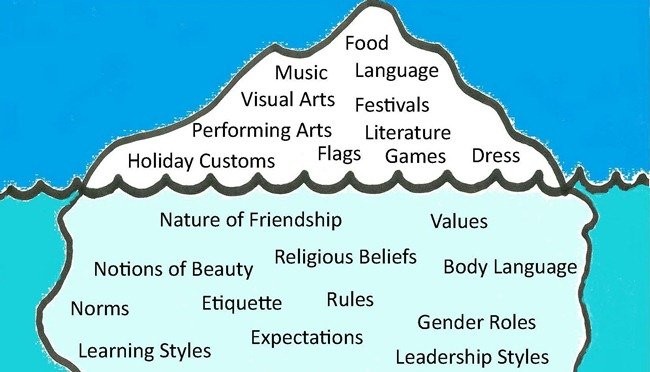
As an cross-cultural consultant, I was trained to analyze communication across cultures and to interpret the differences and similarities among various ethnic groups. One model that is useful when examining culture across nationalities for international marketing or across ethnicities within a country is Geert Hofstede’s Four Manifestations of Culture, (Hofstede, Hofstede, & Minkov, 2010).
Hofstede categorizes the expression of culture from what is most obvious to what is most difficult to perceive and understand. This can be compared to an iceberg in which the symbols, heroes, and rituals are at the tip–the smaller visible area–and the values are hidden and invisible, yet they form the larger area. Below are examples of the Four Manifestations of Culture:
1. SYMBOLS: Colors, food, words, flags, dress, jargon, commodities, and so on.
2. HEROES: Real or unreal characters that personify what is highly prized within a group or nation and who serve as role models or leaders.
3. RITUALS: Collective activities that are essential to maintain cultural groups’ cohesion. For instance, U.S.-born Latino youth watching a soccer game in Spanish with their parents and grandparents is considered a ritual.
4. VALUES: The most subjective and less visible expressions of culture that influence concepts, notions, expectations, perceptions, worldview, and so on.
Most people in general are familiar with the first three of Hofstede’s manifestations because those are learned at home or school while growing up during a process called “enculturation.” To analyze the not so obvious aspects of culture, which are the in-culture shared values, academic training in cross-cultural communication theory and an inherent curiosity are necessary. To be effective in intercultural communication, we need to see beyond our own ethnocentric tendencies by observing differences with total openness. It takes acknowledging and analyzing our own personal biases and stepping out of our comfort zones.
I have heard from many people who say they love learning about other cultures and that is the reason they travel the world and have friends of different ethnicities and nationalities. Traveling exposes people to symbols, the first manifestation of culture, and mingling outside one’s cultural group exposes people to both heroes and rituals. Yet, we can only learn about culture—the stuff that groups share—through socializing, and from close socializing or through acquiring training in cross-cultural communication plus observation and self-inquiry.
To include diverse participants whether your students, your clients, patients, or even your own employees, it is essential to have a basic understanding of cross-cultural communication in order to attain a broader perspective and a deeper understanding of our culturally differences. Finally, only the analysis is cross-cultural. The participants are increasingly diverse because our societies are becoming more multicultural.
REFERENCES:
Hofstede, G., Hofstede, G. J., & Minkov, M. (2010). Cultures and Organizations: Software of the Mind. Revised and expanded 3rd Edition. New York: McGraw-Hill
* The image by James Penstone is licensed under a Creative Commons Attribution-NonCommercial-ShareAlike 2.0 UK: England & Wales License.
Cross Cultural Marketing and Communications Association (CCMCA)
-The CCMCA Promises to Mainstream Us All-

Map of the United States of America showing the largest minority group by color in each state. (Photo credit: Wikipedia)
By Mari D. González
I am pleased to learn that there is a newly formed national professional organization that addresses cross-cultural understanding in marketing –The Cross Cultural Marketing and Communications Association (CCMCA). This organization will facilitate and expand a much-needed cross-cultural perspective in the U.S. Thus, the idea that there is a dominant culture to which everyone should adhere is beginning to lose popularity. This acknowledgment informs us that the exponential growth of U.S. micro cultures, or so- called minority groups, can no longer be ignored.
In the last few decades, the conversation on ethnic marketing has paid a lot of attention to Hispanics. At the beginning of 2013, driven by census results in population growth of Asians, African-Americans, and Latinos and by a larger display of political power from those emerging groups, we began to hear less about Hispanic marketing and more about multicultural marketing.
Nevertheless, the term multicultural had already lost its distinctive meaning because it has been overused. “Multicultural” became the kind of I-feel-good-using-it-but-do-not-know-what-it-really-means expression. It lost meaning because many people used it thoughtlessly. Most people do not dare to learn about the culturally different unless they live in Oakland, CA, where there is greater diversity and they are likelier to make friends with people of other ethnicities.
On the other hand, cross-cultural, which means looking at similarities and differences, places social groups on a level playing field. Cross-cultural communication promises to see groups without any hierarchy, to cross over and even get closer to another cultural group. In cross-cultural communication, we learn by looking at how these cultural groups see themselves as opposed to how they have been perceived by the macro or dominant culture, which in this case, would be considered top-cultural instead of cross-cultural.
As a professional interculturalist who has done cross-cultural analysis in marketing, I could not be more delighted that a nation-wide professional marketing organization now exists and has the potential to address domestic, as opposed to international, issues related to culture in marketing and communications. This is an internal, inside the country, analysis of the relevance that the many ethnicities and social groups have in this country instead of, for instance, looking at the Chinese or the European markets.
Hispanic Marketing – Segmenting Latinos

market 1 (Photo credit: tim caynes)
By Mari D. González
Last year, I was approached by Lee Raymundo, MBA candidate at UCLA. He asked for an interview. He wrote:
“I read your article ‘Marketing to Second-Generation Latinos’ with
great interest and believe your insight would be of great value to me. I have
been trying to understand the behavior and culture of second generation Latinos vs. first generation and what ideals would most likely appeal to them. I understand that Bud Light is especially popular with this segment but have so far, struggled to understand why.”
He explained that his team was working with Budweiser, “on understanding the most effective way to reach the Latino community with a brand that resonates with this segment.” So, we addressed his questions. I gave him a general overview on the language preferences for first- and second-generation Latinos/Hispanics, which are basically related to acculturation.
Based on that particular interview and several other similar conversations, I have concluded that many professionals trying to reach Latinos/Hispanics assume that Latinos/Hispanics fall into one single market–an assumption that is too general.
“Latino/Hispanic” is a term used in census-taking to track people whose
heritage can be traced to 21 countries in Latin America plus Spain (Europe),
but should not be used—or misused—when marketing to a specific population under this umbrella term.Thus, every time I am asked to talk about Latinos/Hispanics, I always reply with the same question, “Which segment of Latinos/Hispanics?”
Most people do not understand the huge cultural, socioeconomic, and generational differences among Latinos aside from their country of origin, language of preference, and acculturation levels. Language is of utmost importance. Yet, it should not be understood simply as English vs.Spanish, but how well the target group speaks either language and how extensive is their vocabulary in either one.
Other questions include: Has the market segment been schooled and/or received college degrees in Spanish or in English? Do they prefer reading in English but speaking Spanish at home? It might be that English is the language they learned to read and write grammatically, but they prefer the emotional connection associated with the sounds and certain words in Spanish. Our accents and the extent of our vocabulary tell a lot about who we are culturally, where we come from, our education and socioeconomic levels–all of which are important marketing indicators for Hispanic marketing strategic planning.
There is also the “American Latino/Hispanic” layer, which encompasses all Latinos/Hispanics living in the U.S. and can be very subtle. For instance, most first-generation, Spanish-dominant Latinos/Hispanics in the U.S. know common English-language terms they use in their daily lives even though their primary language is Spanish at home and work.
Moreover, there are cultural dimensions that second-generation, bilingual and English-dominant Latinos/Hispanics do not give up and that includes collectivism—us, we, nosotros. That is the one specific example I gave to Mr. Raymundo. I told him that whatever message he is trying to communicate across the board with Latinos/Hispanics, do not market to them through an individualistic identity—me, I, only myself—because that’s crossing into assimilation terrain and an assimilated Latino/Hispanic no longer counts culturally as a Latino/Hispanic.
Part-time Anthropologist

English: Art House Hall University Center South in Ciudad Guzman, Jalisco, Mexico Español: Pasillo de Casa del Arte del Centro Universitario del Sur en Ciudad Guzmán, Jalisco, México (Photo credit: Wikipedia)
By Mari D. González
In the December 2009 edition, a writer for The Economist said, “Every foreigner of inquiring mind becomes a part-time anthropologist.” That statement describes me personally and professionally.
I moved to the U.S. in the 90’s. Having completed a B.A. at eighteen, I wanted to explore the world—specifically to learn about people and their culture or their “programming” as Geert Hofstede calls it. My first job in the U.S. was bilingual health educator. At that time, my passion for learning and breaching cultural gaps was greater than my actual English-Spanish bilingual skills.
At fourteen in Mexico, I had moved from my inland hometown to the coast to study. Although it was within the same state, the cultural differences were vast. That was my first intercultural experience. In Ciudád Guzman, my new home, I was called güerita or blonde. As you can see in the picture, my hair is not blonde nor have I ever dyed it, but that was a contextual distinction in a place were most people were darker-skinned than I. Color aside, I wanted to fit in this new place and did not want to be seen as “different.” There were several instances when I would get preferential treatment, which I did not enjoy, such as people getting up from their chairs to let me sit.
I was seen as an outsider and treated like one. I had more privileges because I was perceived as belonging to a higher color-based hierarchy. That’s the type of cultural programming or enculturation that is characteristic of many societies. I found the distinct treatment fascinating, not because of the benefits I got, but because I did not believe I or anyone else deserved such treatment based on appearances. I knew it was a learned attitude that remained unquestioned, and that was my first cross-cultural analysis.
I am back to my writing on intercultural communication, a topic I love. Since my last blog post, I have completed my thesis research and earned a long-awaited Master of Arts degree in Intercultural Relations (MAIR); I am continuing to work on a paper that should be published soon; I have taken several courses in online communication and marketing and passed my written test for medical interpreting. I am happy to be able to write again.
Edited by Connie Cobb

 IXMATI