Home » Posts tagged 'manifestations of culture'
Tag Archives: manifestations of culture
Understanding Geert Hofstede’s Four Manifestations of Culture
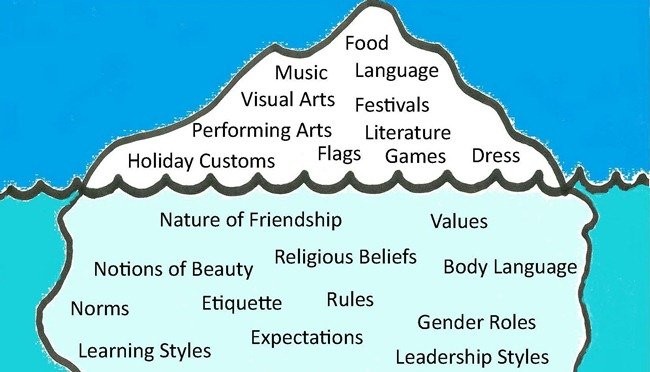
By Mari D. González
As an cross-cultural consultant, I was trained to analyze communication across cultures and to interpret the differences and similarities among various ethnic groups. One model that is useful when examining culture across nationalities for international marketing or across ethnicities within a country is Geert Hofstede’s Four Manifestations of Culture, (Hofstede, Hofstede, & Minkov, 2010).
Hofstede categorizes the expression of culture from what is most obvious to what is most difficult to perceive and understand. This can be compared to an iceberg in which the symbols, heroes, and rituals are at the tip–the smaller visible area–and the values are hidden and invisible, yet they form the larger area. Below are examples of the Four Manifestations of Culture:
1. SYMBOLS: Colors, food, words, flags, dress, jargon, commodities, and so on.
2. HEROES: Real or unreal characters that personify what is highly prized within a group or nation and who serve as role models or leaders.
3. RITUALS: Collective activities that are essential to maintain cultural groups’ cohesion. For instance, U.S.-born Latino youth watching a soccer game in Spanish with their parents and grandparents is considered a ritual.
4. VALUES: The most subjective and less visible expressions of culture that influence concepts, notions, expectations, perceptions, worldview, and so on.
Most people in general are familiar with the first three of Hofstede’s manifestations because those are learned at home or school while growing up during a process called “enculturation.” To analyze the not so obvious aspects of culture, which are the in-culture shared values, academic training in cross-cultural communication theory and an inherent curiosity are necessary. To be effective in intercultural communication, we need to see beyond our own ethnocentric tendencies by observing differences with total openness. It takes acknowledging and analyzing our own personal biases and stepping out of our comfort zones.
I have heard from many people who say they love learning about other cultures and that is the reason they travel the world and have friends of different ethnicities and nationalities. Traveling exposes people to symbols, the first manifestation of culture, and mingling outside one’s cultural group exposes people to both heroes and rituals. Yet, we can only learn about culture—the stuff that groups share—through socializing, and from close socializing or through acquiring training in cross-cultural communication plus observation and self-inquiry.
To include diverse participants whether your students, your clients, patients, or even your own employees, it is essential to have a basic understanding of cross-cultural communication in order to attain a broader perspective and a deeper understanding of our culturally differences. Finally, only the analysis is cross-cultural. The participants are increasingly diverse because our societies are becoming more multicultural.
REFERENCES:
Hofstede, G., Hofstede, G. J., & Minkov, M. (2010). Cultures and Organizations: Software of the Mind. Revised and expanded 3rd Edition. New York: McGraw-Hill
* The image by James Penstone is licensed under a Creative Commons Attribution-NonCommercial-ShareAlike 2.0 UK: England & Wales License.

 IXMATI