Home » cross-cultural
Category Archives: cross-cultural
Understanding Geert Hofstede’s Four Manifestations of Culture
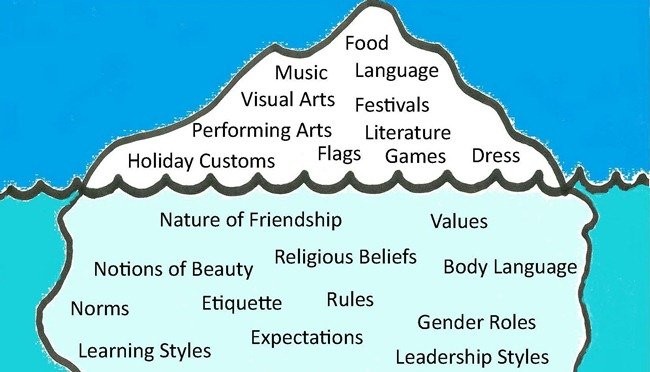
By Mari D. González
As an cross-cultural consultant, I was trained to analyze communication across cultures and to interpret the differences and similarities among various ethnic groups. One model that is useful when examining culture across nationalities for international marketing or across ethnicities within a country is Geert Hofstede’s Four Manifestations of Culture, (Hofstede, Hofstede, & Minkov, 2010).
Hofstede categorizes the expression of culture from what is most obvious to what is most difficult to perceive and understand. This can be compared to an iceberg in which the symbols, heroes, and rituals are at the tip–the smaller visible area–and the values are hidden and invisible, yet they form the larger area. Below are examples of the Four Manifestations of Culture:
1. SYMBOLS: Colors, food, words, flags, dress, jargon, commodities, and so on.
2. HEROES: Real or unreal characters that personify what is highly prized within a group or nation and who serve as role models or leaders.
3. RITUALS: Collective activities that are essential to maintain cultural groups’ cohesion. For instance, U.S.-born Latino youth watching a soccer game in Spanish with their parents and grandparents is considered a ritual.
4. VALUES: The most subjective and less visible expressions of culture that influence concepts, notions, expectations, perceptions, worldview, and so on.
Most people in general are familiar with the first three of Hofstede’s manifestations because those are learned at home or school while growing up during a process called “enculturation.” To analyze the not so obvious aspects of culture, which are the in-culture shared values, academic training in cross-cultural communication theory and an inherent curiosity are necessary. To be effective in intercultural communication, we need to see beyond our own ethnocentric tendencies by observing differences with total openness. It takes acknowledging and analyzing our own personal biases and stepping out of our comfort zones.
I have heard from many people who say they love learning about other cultures and that is the reason they travel the world and have friends of different ethnicities and nationalities. Traveling exposes people to symbols, the first manifestation of culture, and mingling outside one’s cultural group exposes people to both heroes and rituals. Yet, we can only learn about culture—the stuff that groups share—through socializing, and from close socializing or through acquiring training in cross-cultural communication plus observation and self-inquiry.
To include diverse participants whether your students, your clients, patients, or even your own employees, it is essential to have a basic understanding of cross-cultural communication in order to attain a broader perspective and a deeper understanding of our culturally differences. Finally, only the analysis is cross-cultural. The participants are increasingly diverse because our societies are becoming more multicultural.
REFERENCES:
Hofstede, G., Hofstede, G. J., & Minkov, M. (2010). Cultures and Organizations: Software of the Mind. Revised and expanded 3rd Edition. New York: McGraw-Hill
* The image by James Penstone is licensed under a Creative Commons Attribution-NonCommercial-ShareAlike 2.0 UK: England & Wales License.
Unlocking Cross-Cultural Communication in the Indian Context

By Mari D. González
This article is in response to a request I received on my blog. Based on the greeting, I assumed it came from a person in India. Please read below:
“Dear ma’am,
Can you please explain the difference between intercultural communication and cross-cultural communication in the Indian context or in the form in which we can make a role- play. It is very important to us but we could not find the proper explanation anywhere on the internet.”
In 2011, while in graduate school, I wrote an article titled, CROSS-CULTURAL vs. INTERCULTURAL, after listening to an awkward, inaccurate, and rather dismissive explanation of these terms at a large O’Reilly marketing conference in San Francisco. This blog article gets an average of 35 views per day from all over the world and I often get contacted with additional questions such as the one today.
Because it sounded as if this was related to a school assignment and because I love these topics, I answered diligently. Please see my reply below:
“Intercultural communication is what happens, for example, when a Punjabi marries a Bengali. Think of the wedding conversations or even the miscommunication ‘between’ the families from both sides.
Cross-cultural communication relates to your own ideas and knowledge about Punjabis vs Bengalis. It does not require interaction, only observation, and interpretation. You could say, Punjabis are very extroverted in the context of Bengalis, for example.
If you read my previous article, you’ll notice that it is merely a cross-cultural analysis of Mexican and Indian philosophies based on my own experience and understanding. It is not an intercultural communication analysis because I am not referring to what happens when a philosopher from Mexico meets another philosopher from India.”
Please let me know if this makes sense. I’ll be happy to continue this conversation. Best wishes on your assignment!”
The response I received was, “Yes, It makes sense, Thank you so much!!.”
You can find more articles in this category, here.
*Picture from From Wikimedia Commons; File: Indian Wedding Ceremony (413).jpg; Author: Benipal Hardarshan
Low-Context, High-Context, and Losing Face?

By Mari D. González
According to anthropologist and intercultural communication pioneer, Edward T. Hall, North European and North American macro-cultures would be defined as “Low-context.” Their communication preference is characterized by explicit verbal messages. Hall explains that in Low-context, “Effective verbal communication is expected to be direct and unambiguous.” Low-context communication is related to an individualistic identity in which people are “I” conscious and express private opinions publicly.
Societies from the rest of the world including Latin America, Asia, and Arab countries utilize High-context communication in which, “most of the information is part of the context or internalized in the person; very little is made explicit” (Hall, as cited by de Mooij, 2014). In these countries, people are programmed to read context and meaning between words.
In High-context or collectivist societies expressing personal opinions and disregarding the group of reference’s perceptions is not the norm. The personal identity is related to the group of reference and a shared “we” identity. There is a risk of making them feel uncomfortable. An offense to a person of that cultural group is an offense to all the in-group members to which Asians call “losing face.”
* Image by Icons8 Team on Unsplash
Super Bowl and the American Ethos

By Mari D. González
If one wonders what the U.S. American ethos is, one can see it fully represented in the Super Bowl ads–the dreams, the myths, the wishes, the material values, the perceived beauty, the wishful thinking, and what should or could be.
It is in marketing that those ideal values get updated to be more inclusive and reflect what we observe in daily life–an obvious ethnic diversity–made up of continuous waves of immigrants that keep moving this country forward.
Discover the Complexities of Low- and High-Context Communication in Healthcare

By Mari D. González
As a cross-cultural communication consultant and former professional medical interpreter, I found cultural contexts the most challenging and fascinating aspect of translating between Spanish-dominant–who are from a high-context culture–patients and English-dominant doctors–who are from a low-context culture–during medical interpreting assignments.
Cross-cultural communication refers to the comparing and contrasting of different communication styles based on culture. One of the basic tenets in cross-cultural communication is the influence of our personal and social identities on the way we communicate.
If we are dominant in one language—in the case of monolingual speakers—or more dominant in one language than another—in the case of Spanish-dominant or English-dominant speakers—a particular cultural programming or set of values, world view, or behavior always dominates when we converse. Harry C. Triandis observes in his article, “The Self and Social Behavior in Differing Cultural Contexts” that “People who speak different languages or live in nonadjacent locations…have different subjective cultures” (1989, p. 506). Our dominant or primary language provides an essential clue into our social upbringing and communication styles.
Spanish-dominant Latinos/Hispanics are predominantly “collectivist” and “high context” due to their group-based identity and their ability to get implied meanings in oral communication. Triandis further states, “Individualists give priority to personal goals over the goals of collectives; collectivists either make no distinctions between personal and collective goals, or if they do make such distinctions, they subordinate their personal goals to the collective goals” (p. 509).
Generally, Spanish-dominant patients lack the necessary knowledge of U.S. culture to completely understand the narrowness, linear-ness, and precision of “individualist” or “low context” communication. On the other hand, a medical provider or physician whose primary language is English may often get frustrated by the expansiveness, circular-ness and all-over-the-place “high-context” communication style of Spanish-dominant patients.
The medical interpreter, in her role as cultural broker, performs a delicate balancing act: She has to explain to doctors that the patient is giving the context for his or her answer while explaining to the patient that the doctor is looking for a precise, specific, and short answer. Impatience is the doctor’s natural reaction to a perceived overload of information. This need for exactness is crucial in the financial, accounting, and technology fields, but it is not always recommended at the doctor’s office because impatience does not help in building trust. It results in patients not asking the right questions or reporting inaccurate information due to a fear that the doctor may get upset.
People from collectivist cultures, such as Spanish-dominants, value harmony over confrontation. Harmony is an essential value if you come from a large and extended family. Maintaining harmony and balance is a requirement to keep large groups functioning. Furthermore, people from high-context societies sharply scan emotions and grasp what was not explicitly said. It does not matter if a doctor smiles at the patient while being impatient. The emotion and what he or she implied was perceived first.
To mediate this exchange of low context and high context communications, medical interpreters find themselves repeating the doctor’s linear and precise questions to patients who typically give the whole context by using stories and not answering with a yes or no or with a specific number. Most patients eventually understand that their doctors are looking for clear-cut information, but they do not always understand why the rest of the information is not as important.
Let’s not confuse a basic-to-intermediate-level of fluency in a foreign language with understanding the culture of those who speak it as their primary language. Applicants for jobs as health care providers may include fluency in Spanish, or any other second language for that matter, among their qualifications, but that may indicate nothing about their “cultural fluency.” Cultural fluency is gained through socialization or a constant association with those who speak a different language, which promotes a sense of shared comfortableness. If language fluency was acquired indirectly through digital media such as online courses or applications, or even through academic courses that are devoid of people from that culture, the cultural fluency that allows one to perceive differences in communications styles will be lacking.

 IXMATI