Home » Articles posted by Mari D. Gonzalez (Page 3)
Author Archives: Mari D. Gonzalez
Acculturation Is Not Assimilation

By Mari D. González
Assimilation is a process in which people with a different culture of origin completely adapt to the culture of residency, leaving behind traits from their culture of origin. That has been the expected social standard in the U.S. for all immigrants. Latinos have not and will not completely assimilate, culturally, that is.
Latinos and Americans are “acculturating” to each other by borrowing traits and merging cultures as a result of prolonged contact. Acculturation and assimilation are two different terms and should not be used interchangeably.
Uncover the Languages of the World

By Mari D. González
“Language is the code through which culture is communicated among in-culture members. It is often misinterpreted by out-culture members when it is not accurately translated.”
Happy 2024!
*The infographic was originally published in scmp.com
Spanglish is Slowly but Surely Being Part of the U.S. Popular Culture

By Mari D. González
Bilingual youth who construct their vocabulary between what they learn at home in Spanish and what they learn at school or work in English are more comfortable with a casual language among their peers that mixes phrases and words of these two languages, commonly known as Spanglish. Spanglish, however, is not simply picking a word or two from Spanish and mixing them up with English as non-Spanglish speaking marketers would like to think and wrongly try it on their advertisement campaigns.
Spanglish is a delicate form of incorporating words to one’s vocabulary in the language they were learned first. In general, words associated with family, emotions, and close relationships might be in Spanish. Words learned first at school might be in English. Spanglish, then solidifies when a group of people shares the same set of words in both languages without the need to translate them into a second language.
According to my research study on language preferences in digital media among second-generation, Latinos/Hispanics, the less acculturated ones side with Spanglish-themed Netflix series and music such as the Bad Bunny phenomenon because traditional media does not resonate with who they are collectively.
*The image is by www.ushispanicministry.com
Exploring the Spiritual Roots from East Indian to Mexican Philosophy
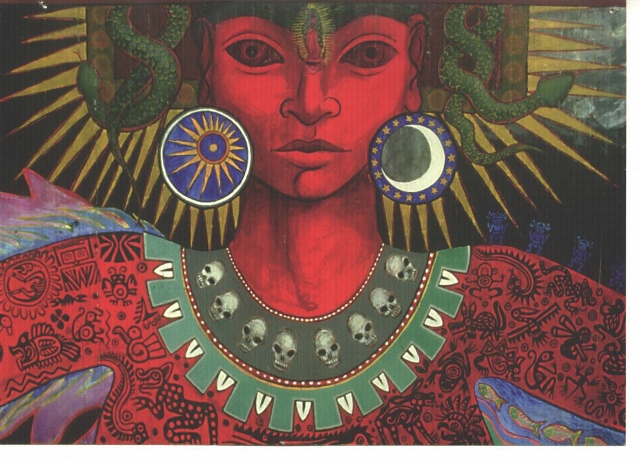 By Mari D. González
I grew up in Mexico. We have a very unique religion that sets us apart from the world. Although on the outside it might be seen as pure Catholicism, the essence is Indigenous. The most revered deity is the Virgin of Guadalupe, not Jesus. In that sense, we are not necessarily Christians but Guadalupanos (Dr. Jalife-Rahme). Mexican’s virgin is the western Virgin Mary fused with the Native American goddess of Tonantzin.
Para Los Pueblos Originarios de México, the natural world, and the Cosmos are very relevant. Southern Mexico’s original languages are very spiritual and grounded in nature. For example, the word “heart” is often used in the indigenous languages’ conversations to express that one is talking from deep within and with endearment. We have the word “corazonada” which can be translated as “from the heart” which is very common among Mexicans to express intuition.
The closer I get to my indigenous spirituality, the more relevant and absorbable Vedic concepts are for me. Therefore, when I read the word “Heart” in the book, The Teachings of Ramana Maharshi, I understood it with a deeper, close-to-home experience.
I am on a quest to learn more about my indigenous spiritual roots to make awakening more relevant to my own experience as a Spanish speaker who grew up in Mexico. English is my second language and the British/US culture is an added layer to my worldview. From the perspective of the Spanish language and Mexican culture (High-Context), I perceive both the English language and the British/US culture as narrower (Low-Context). It is expected that several concepts will be lost in translation between Indian thought translated into British English and the Mexican perspective when reading Indian sacred books in English. I find it helpful to trust my “heart intuition” when I find myself at a concepts’ crossroads.
Mexico’s 5,000 years of culture, civilization, and spirituality–Mayan, Tolteca, Zapoteca, Olmeca, Totonaca, Mexica or Azteca, and Teotihuacana–are comparable to India’s old history. Unfortunately, just like Indians lost a lot of sacred books to Muslim control, old Mexico lost most of their venerated writings to the Catholic Spaniards during their 300 hundred years of colonization. During that time, what was not lost, it was syncretized. However, Indigenous culture is very palpable among Mexicans. It is in our genes. It is what sets us apart. The way we socialize, relate to others, see the world, our food, and our spirituality are more Indigenous than Spaniards. Our philosophical history is not easily available to study and there are not be accessible books to read and study. The essence of our philosophy has been taught by parents to their children just as in our whole culture.
Currently, more youth and adults are making efforts to revive, reconnect with, and conserve our Indigenous culture. We see more people in leadership positions wearing Indigenous attire with pride. We are in the introspection identity development stage due to the high toll on the Mexican economy, public health, and political corruption. What has kept us going is the culture which includes our millenary spiritual values and indigenous cosmology whether we have Indigenous genes or not.
An Argentinian Yoga instructor told me once that for Mexicans it is easier to connect to ancient Indian wisdom because of our old indigenous roots. Yet, we still need to make the necessary adaptations and avoid wrong interpretations. This will ensure relevancy and meaningfulness to our individual and cultural experiences. Love (heart), awareness, and spirituality as in humanness are “one” in Indian and Mexican philosophies or any other philosophy for that matter.
Yet, we need to understand that even when our destination might be the same–finding the ultimate truth,–our paths to arrive are not the same. We all take different modes of transportation and roads. Additionally, as human beings, we also have the inherent need for meaning continuation. In this process, we go from our uniqueness–diversity or analysis–into that Oneness–inclusion or synthesis.
* Tonantzin Image by Monaghan BGH 290; Gunn Allen SH 45
By Mari D. González
I grew up in Mexico. We have a very unique religion that sets us apart from the world. Although on the outside it might be seen as pure Catholicism, the essence is Indigenous. The most revered deity is the Virgin of Guadalupe, not Jesus. In that sense, we are not necessarily Christians but Guadalupanos (Dr. Jalife-Rahme). Mexican’s virgin is the western Virgin Mary fused with the Native American goddess of Tonantzin.
Para Los Pueblos Originarios de México, the natural world, and the Cosmos are very relevant. Southern Mexico’s original languages are very spiritual and grounded in nature. For example, the word “heart” is often used in the indigenous languages’ conversations to express that one is talking from deep within and with endearment. We have the word “corazonada” which can be translated as “from the heart” which is very common among Mexicans to express intuition.
The closer I get to my indigenous spirituality, the more relevant and absorbable Vedic concepts are for me. Therefore, when I read the word “Heart” in the book, The Teachings of Ramana Maharshi, I understood it with a deeper, close-to-home experience.
I am on a quest to learn more about my indigenous spiritual roots to make awakening more relevant to my own experience as a Spanish speaker who grew up in Mexico. English is my second language and the British/US culture is an added layer to my worldview. From the perspective of the Spanish language and Mexican culture (High-Context), I perceive both the English language and the British/US culture as narrower (Low-Context). It is expected that several concepts will be lost in translation between Indian thought translated into British English and the Mexican perspective when reading Indian sacred books in English. I find it helpful to trust my “heart intuition” when I find myself at a concepts’ crossroads.
Mexico’s 5,000 years of culture, civilization, and spirituality–Mayan, Tolteca, Zapoteca, Olmeca, Totonaca, Mexica or Azteca, and Teotihuacana–are comparable to India’s old history. Unfortunately, just like Indians lost a lot of sacred books to Muslim control, old Mexico lost most of their venerated writings to the Catholic Spaniards during their 300 hundred years of colonization. During that time, what was not lost, it was syncretized. However, Indigenous culture is very palpable among Mexicans. It is in our genes. It is what sets us apart. The way we socialize, relate to others, see the world, our food, and our spirituality are more Indigenous than Spaniards. Our philosophical history is not easily available to study and there are not be accessible books to read and study. The essence of our philosophy has been taught by parents to their children just as in our whole culture.
Currently, more youth and adults are making efforts to revive, reconnect with, and conserve our Indigenous culture. We see more people in leadership positions wearing Indigenous attire with pride. We are in the introspection identity development stage due to the high toll on the Mexican economy, public health, and political corruption. What has kept us going is the culture which includes our millenary spiritual values and indigenous cosmology whether we have Indigenous genes or not.
An Argentinian Yoga instructor told me once that for Mexicans it is easier to connect to ancient Indian wisdom because of our old indigenous roots. Yet, we still need to make the necessary adaptations and avoid wrong interpretations. This will ensure relevancy and meaningfulness to our individual and cultural experiences. Love (heart), awareness, and spirituality as in humanness are “one” in Indian and Mexican philosophies or any other philosophy for that matter.
Yet, we need to understand that even when our destination might be the same–finding the ultimate truth,–our paths to arrive are not the same. We all take different modes of transportation and roads. Additionally, as human beings, we also have the inherent need for meaning continuation. In this process, we go from our uniqueness–diversity or analysis–into that Oneness–inclusion or synthesis.
* Tonantzin Image by Monaghan BGH 290; Gunn Allen SH 45
American Youth Are More Contextual

By Mari D. González
I’m pleased to see how millennials are influencing our current society. They have acquired a broader awareness of their social and global environments than previous generations.
New generations are more “contextual” or high context and are influencing the workplace and our current societal values. They are more in tune with their social and physical environments and have a sense of a global community. They care more about world affairs and social causes.
These facts are relevant to cross-cultural communication because millennials and Gen Z are changing the emerging American culture. These changes are due to the circularity and interconnectedness of online communication and to the fact that a great majority of youth come from cultures that are collectivist such as Latino and Asian.
* Image by Jake Ingle on Unsplash

 IXMATI